


AI Coaching vs. Online Therapy vs. Traditional Therapy

Which Approach Is Right for You?
Emotional support and relationship counselling are no longer limited to a couch in a doctor's office. Today, you have three distinct choices: Traditional In-Person Therapy, Online Human Therapy (video calls), and the rapidly growing field of AI Coaching.
But how do you know which one fits your needs?
While traditional therapy offers deep clinical intervention, AI-powered support is revolutionizing the industry by solving the three biggest barriers to care: Cost, Speed, and Stigma.
This guide breaks down the differences, benefits, and limitations of each method to help you decide.
The 3 Main Types of Therapy Explained
1. Traditional In-Person Therapy
This is the classic model: you visit a licensed psychologist’s office for a 50-minute session. It relies on face-to-face interaction, body language reading, and a long-term therapeutic relationship.
2. Human-Led Online Therapy (Telepsychology)
Popularized by platforms like BetterHelp, this connects you with a licensed human therapist via video call or text. It offers the same clinical expertise as in-person therapy but eliminates the commute.
3. AI Coaching
This is the newest innovation. Using advanced algorithms trained on CBT (Cognitive Behavioral Therapy), ACT (Acceptance and Commitment Therapy), Jungian Psychology, and Neuroscience, AI therapists provide immediate, simulated therapeutic conversations. There are no appointments; the AI is available 24/7 for emotional support, stress regulation, and coaching.
Comparison at a Glance
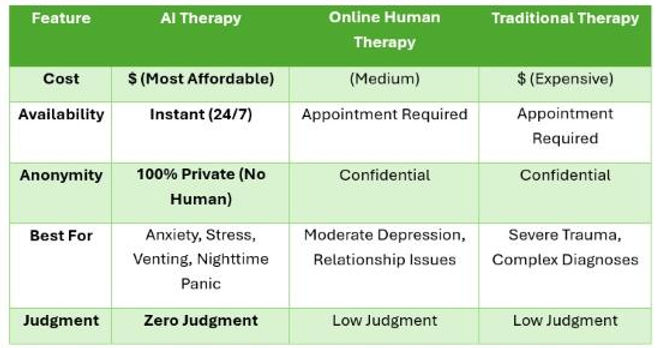
AI Coaching (or therapy)
-
Cost: Most affordable option ($)
-
Availability: Instant access, available 24/7
-
Anonymity: 100% private, no human involved
-
Best for: Anxiety, stress, venting, nighttime panic
-
Judgment: Zero judgment
Online Human Therapy
-
Cost: Medium range ($$)
-
Availability: Requires scheduled appointments
-
Anonymity: Confidential, handled by a professional
-
Best for: Moderate depression, relationship issues
-
Judgment: Low judgment
Traditional Therapy
-
Cost: Most expensive option ($$$)
-
Availability: Requires scheduled appointments
-
Anonymity: Confidential, handled in person
-
Best for: Severe trauma, complex diagnoses
-
Judgment: Low judgment
The Case for AI Coaching: Speed & Anonymity
While AI cannot replace the intuition of a human doctor for severe psychiatric disorders, it excels in areas where traditional therapy fails.
1. The "2 AM" Problem
Human therapists sleep. Anxiety does not. AI Therapy is the only modality that offers instant regulation during a panic attack at 3 AM. It bridges the gap between a crisis and your next appointment.
2. The "Digital Confessional" (Total Anonymity)
Many people delay therapy because they feel shame. They are afraid to tell another human being their deepest secrets. AI removes this barrier. Because you are talking to a non-judgmental algorithm, users often report feeling safer opening up about taboo topics or social anxiety.
3. Data-Driven Objectivity
Unlike humans, who have bad days or biases, AI is consistent. Systems trained on CBT and Neuroplasticity can guide you through evidence-based exercises to rewire negative thought patterns without fatigue.
When is Human Therapy Better?
To be clear: AI is a powerful tool for emotional support and coaching, but it is not a replacement for clinical psychiatric treatment for severe conditions.
You should choose a Human Therapist (Online or In-Person) if:
-
You are dealing with severe trauma (PTSD) or complex personality disorders.
-
You require medication management.
-
You are in an active crisis or self-harm situation.
-
You need a diagnosis for insurance or legal purposes.
Efficacy & The Future of Mental Health
Is AI effective? A 2021 review in The Lancet Digital Health noted that AI-powered conversational agents provided significant short-term psychological benefits. Furthermore, studies suggest that Internet-based Cognitive Behavioral Therapy (iCBT) can be as effective as face-to-face therapy for anxiety and mild depression.
The Hybrid Future
The future isn't "AI vs. Humans." It is likely a hybrid model. Many users now use AI Therapy for daily maintenance, journaling, and immediate stress relief, while seeing a human therapist once a month for deeper work.
Which Should You Choose?
-
Choose Traditional/Online Human Therapy if: You have a diagnosed condition, deep trauma, or want a long-term human bond.
-
Choose AI Coaching if: You need immediate relief, you are on a budget, you have social anxiety, or you want a safe, anonymous space to explore your emotions without waiting lists.
Ready to try the future of emotional support?
Experience the judgment-free, instant support of AI.
FAQ about AI Coaching vs Human Therapy
Is AI Coaching as effective as traditional therapy?
AI therapy and traditional therapy serve different purposes and have different strengths. Research shows AI-powered support can be effective for early-stage stress, anxiety, relationship difficulties, and everyday emotional processing. Traditional therapy with a licensed clinician is more appropriate for clinical conditions, trauma, psychiatric diagnosis, and complex mental health needs. AI therapy is not a replacement for clinical care — but for accessibility, anonymity, cost, and 24/7 availability, it serves a distinct and valuable role.
What is the main difference between AI Coach and online therapy?
Online therapy typically connects you to a licensed human therapist through a digital platform — it is traditional therapy delivered remotely. AI therapy uses artificial intelligence trained in psychological frameworks to provide support without a human therapist. AI therapy offers 24/7 instant availability with no waitlists and lower cost, while online therapy with a human offers clinical diagnosis, legally regulated care, and the irreplaceable element of human relationship.
When should I choose AI Coach over traditional therapy?
AI therapy is well-suited for: everyday emotional processing and stress management, support between therapy sessions, situations where anonymity is important, immediate support when a therapist is unavailable, early-stage relationship or emotional difficulties, and when cost or waitlists make traditional therapy inaccessible. Traditional therapy should be chosen for clinical diagnosis, severe mental health conditions, trauma processing, psychiatric medication, or any situation requiring legally regulated clinical care.
How much cheaper is AI coaching or therapy compared to traditional therapy?
Traditional therapy in the US typically costs $100 to $300 per 50-minute session, with an average cost of around $150 per session. Therapy-Chats plans start from $14.90 per month for unlimited messaging — making AI emotional support approximately 90-95% more affordable than a single traditional therapy session, with no appointment needed and 24/7 availability.